

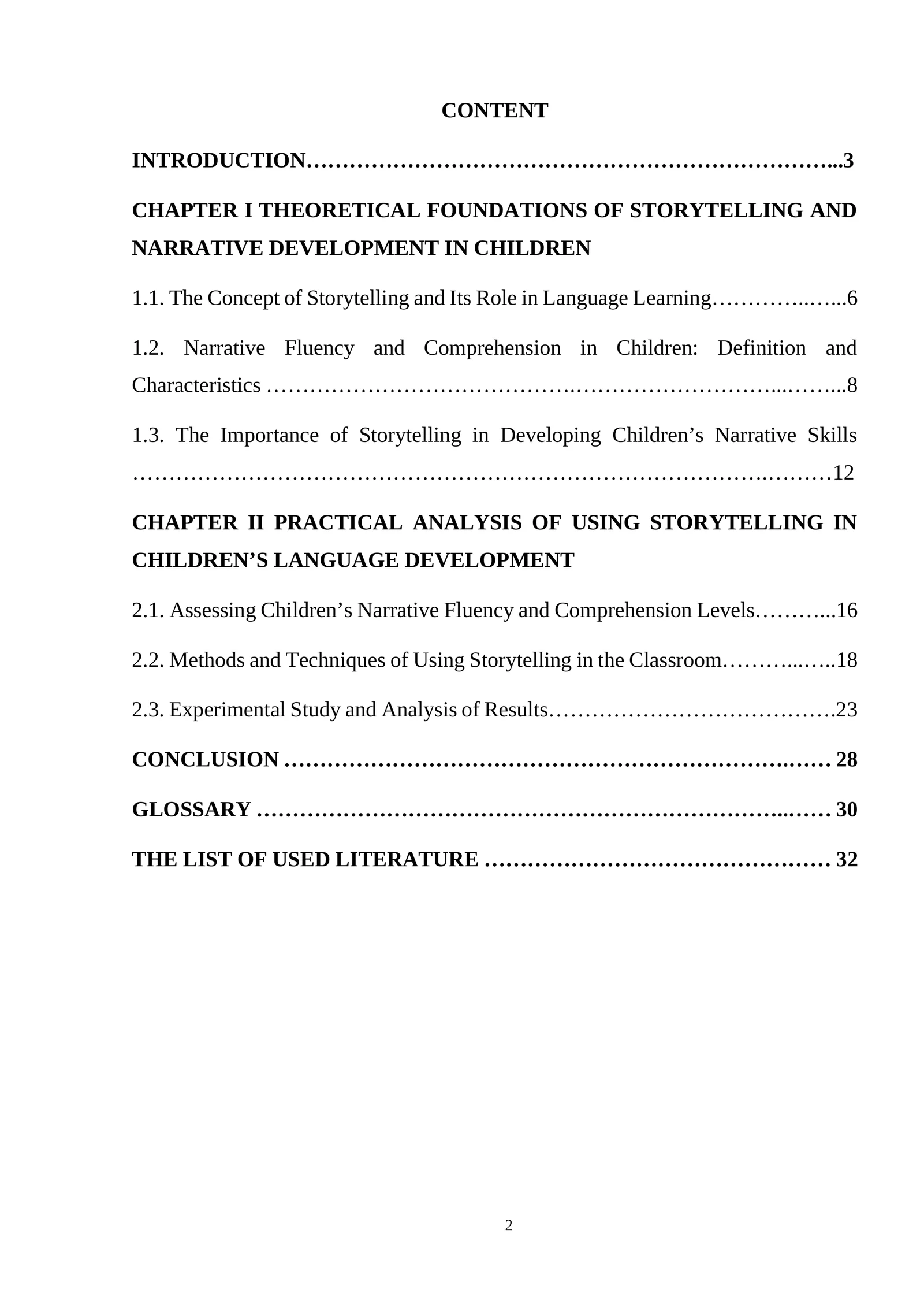
THEORETICAL FOUNDATIONS OF STORYTELLING AND NARRATIVE DEVELOPMENT IN CHILDREN
Kurs ishlari | Ingliz tili



25 000 so'm
- Betlar soni:31 ta
- Fayl hajmi :74.19 KB
- Fayl turi:.docx
Mahsulot tavsifi
CONCLUSION
The present coursework has explored the theoretical and practical aspects of using storytelling as a method for enhancing narrative fluency and comprehension in children. Based on the analysis conducted in Chapter I, it can be concluded that storytelling is not only a traditional form of communication but also a powerful pedagogical tool that supports linguistic, cognitive, and social development. Narrative fluency and comprehension were identified as essential components of communicative competence, enabling children to express their ideas coherently and understand meaning effectively in various contexts.
The theoretical review demonstrated that storytelling creates a meaningful and engaging learning environment in which children can develop language skills naturally. It integrates listening, speaking, reading, and writing skills while also fostering creativity, imagination, and critical thinking. Furthermore, storytelling contributes to vocabulary enrichment, grammatical development, and the ability to construct structured narratives.
The practical part of the research, presented in Chapter II, provided empirical evidence supporting the effectiveness of storytelling in language learning. The results of the experimental study clearly showed that children who were taught using storytelling-based methods demonstrated significantly greater improvement in narrative fluency, coherence, vocabulary usage, and comprehension compared to those who were taught using traditional methods. In particular, the experimental group showed remarkable progress in organizing ideas, maintaining logical sequence, and expressing thoughts more confidently.
The findings of the study confirm that storytelling-based instruction creates a dynamic and interactive learning environment that increases learner motivation and participation. Activities such as retelling, role-playing, and group storytelling were especially effective in promoting active engagement and developing communicative skills. At the same time, the study highlighted the importance of integrating storytelling with other instructional techniques, particularly grammar-focused activities, in order to ensure balanced language development.
Based on the results obtained, several important conclusions can be drawn. First, storytelling should be considered a key methodological approach in teaching language to children, as it reflects natural language use and supports holistic development. Second, the integration of language skills within storytelling activities enhances both receptive and productive abilities, leading to more effective communication. Third, the success of storytelling-based instruction depends on careful lesson planning, appropriate selection of methods, and the teacher’s ability to create an engaging and supportive learning environment.
In terms of practical recommendations, it is suggested that teachers incorporate storytelling into their regular teaching practice by designing lessons that include pre-, while-, and post-storytelling activities. The use of visual aids, digital tools, and collaborative tasks can further enhance the effectiveness of storytelling. Teachers should also employ continuous assessment methods to monitor students’ progress and provide feedback that supports their development.
Despite the valuable findings of this study, certain limitations should be acknowledged. The experimental study was conducted over a relatively short period and involved a limited number of participants. Future research could expand the sample size and explore the long-term effects of storytelling on language development. Additionally, further studies could investigate the use of digital storytelling and its impact on learners’ engagement and performance.
In conclusion, storytelling is a highly effective and versatile method for developing children’s narrative fluency and comprehension. It promotes meaningful communication, enhances motivation, and supports the integration of multiple language skills. Therefore, its implementation in language teaching should be encouraged as a central component of modern pedagogical practice.


Ziyodaxon Parpiyeva Sherzodjon qizi
Yuklanmoqda...
0 ta izoh